
Los Cabos entered 2026 with a familiar problem for a high-profile destination: a small shift in air arrivals can quickly become a large public narrative. FITURCA, the Los Cabos Tourism Trust, has answered that concern with data showing a more stable picture. International demand remains strong, the United States and Canada continue to anchor the destination, and tourism spending is still flowing through hotels, restaurants, transportation, local services, and non-tourism businesses. For travelers, investors, operators, and Baja California Sur residents, the lesson is clear: Los Cabos is not free from market pressure, but the data does not support a collapse story.
Why FITURCA Data Matters For The Los Cabos Tourism Narrative
Los Cabos is one of Mexico’s most closely watched luxury and leisure destinations, so even modest demand changes can attract outsized attention. The problem is that tourism narratives often move faster than tourism data. A social media claim, a single quiet week, or a soft domestic travel month can become a broad statement about the destination before official figures catch up.
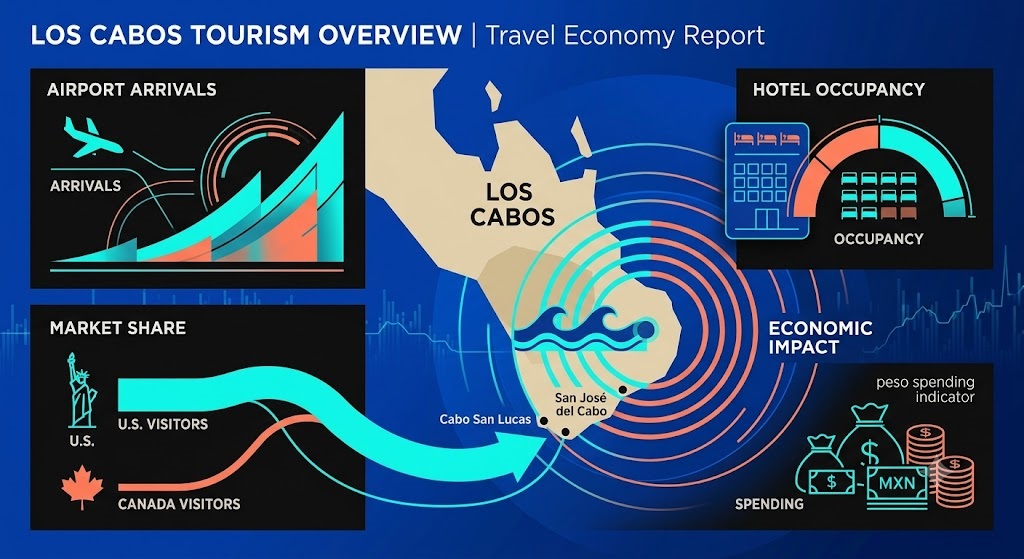
FITURCA’s role is important because it gives the conversation a measurable base. The organization’s tourism observatory tracks airport arrivals, hotel performance, tourist origin markets, visitor behavior, and destination indicators through sources such as Grupo Aeroportuario del Pacífico, AHLC, INM-SIOM, and tourist surveys. That structure helps separate a real market adjustment from a headline that overstates the problem.
The January 2026 FITURCA Tourism Observatory reported 328,500 passenger arrivals at Los Cabos International Airport. That was only 0.3% lower than January 2025. More important for the international-demand question, international passengers reached 219,000, up 2.6% year over year, while domestic passengers fell 5.6% to 109,600. That mix points to a destination where domestic demand softened early in the year, but foreign air demand remained positive according to the FITURCA tourism statistics.
This distinction matters for BajaTimes readers because Los Cabos travel decisions are rarely shaped by one number. A hotel operator cares about occupancy and rate. A restaurant cares about spend. A traveler cares about flight access, value, and crowd timing. A resident cares about jobs, wages, traffic, and local business impact. FITURCA’s data gives each of those groups a better way to read the destination.
International Demand Is Still The Core Strength
The international market remains the foundation of Los Cabos’ tourism model. FITURCA’s January 2026 observatory placed the United States at 47.8% of the issuing-market share, up 1.2 percentage points year over year. Canada accounted for 19.1%, up 2.6 percentage points. Domestic travel represented 31.5%, down 2.2 percentage points, while other international markets represented 1.6%.
That market structure explains why the phrase “tourism is down” can be misleading. A destination can experience a domestic adjustment and still maintain a strong international profile. Los Cabos continues to depend heavily on U.S. and Canadian travelers who arrive by air, book hotels or vacation rentals, use restaurants, reserve tours, and support service jobs across Cabo San Lucas, San José del Cabo, and the Tourist Corridor.
FITURCA’s January 2026 hotel data also supports a measured reading. The observatory reported 74% hotel occupancy for the month, unchanged from the same month a year earlier. Average daily rate was $499, down 1.8% year over year, and RevPAR was $369, down 1.9%. Those figures show pressure on rate and revenue per available room, but not a demand shock.
That is the right lens for 2026. Los Cabos is not in an untouched boom, and it is not in a sudden demand failure. It is operating in a more competitive, price-sensitive travel environment where international demand remains a stabilizing force. That also connects with BajaTimes’ earlier coverage of the Cabo luxury hotel boom, where new high-end inventory raised questions about how much premium demand the market can absorb.
Why A Small Airport Adjustment Does Not Equal A Destination Crisis
A first-quarter slowdown deserves attention, but it should be read in context. Reporting on FITURCA’s clarification said Los Cabos International Airport recorded a 2.5% decline in passenger traffic during the first quarter of 2026 compared with the same period in 2025. The same report said the international market showed only a 0.7% decrease, while the domestic market posted a 6.1% adjustment.
Those numbers suggest a market that is cooling selectively, not collapsing broadly. International travel remains close to the previous year’s level after years of growth, while domestic demand appears more sensitive to pricing, flight availability, economic pressure, and competing Mexican destinations.
The stronger signal is economic impact. In March 2026, tourism generated 14.6 billion pesos in Los Cabos, a 2.8% increase from the same month a year earlier, according to the same FITURCA-related reporting. It also said 35% of that spending reached non-tourism sectors, including local businesses, bars, transportation, and health services. That matters because tourism value is not measured only by arrivals. Spending distribution is part of the destination’s economic health.
Employment data adds another layer. Tourism-sector jobs reached 47,093 during the fourth quarter of 2025, up 7% from the prior year, and tourism-related income was reported at 40.2% above the overall Baja California Sur average. For local households, that makes the stability of the tourism economy more than a hotel-industry topic. It connects directly to wages, service jobs, supplier demand, and small-business survival.
What The 2025 Baseline Says About 2026
The 2026 debate should also be measured against the 2025 baseline. FITURCA’s January 2026 Spanish observatory showed Los Cabos closed 2025 with 3.7664 million passenger arrivals at Los Cabos International Airport, up 0.6% from 2024. International passenger arrivals reached 2.3442 million, up 0.7%, while domestic passenger arrivals reached 1.4222 million, up 0.5%.

That annual baseline matters because it shows why a minor early-2026 adjustment does not erase the destination’s broader demand position. Los Cabos came into the year from a high-volume base, not from a weak recovery period. A market operating near a high point can show slower percentage growth without losing its destination strength.
Hotel figures from the same 2025 year-end period point to the same interpretation. Los Cabos recorded 70.4% annual hotel occupancy, up 0.2 percentage points from 2024, and an average daily rate of $439.9 for the year. December 2025 showed 72% occupancy, down 2 percentage points from December 2024, with an average daily rate of $557 for the month.
That mix shows why the destination story needs discipline. Some indicators are flat. Some are slightly softer. Some remain strong. A practical analysis should not turn every negative comparison into a warning sign, and it should not pretend that pricing pressure, domestic softness, or luxury inventory growth are irrelevant.
| Indicator | What FITURCA Data Shows | What It Means For Readers |
|---|---|---|
| January 2026 Total Airport Arrivals | 328,500 passengers, down 0.3% year over year | Overall traffic was nearly flat, not sharply down |
| January 2026 International Arrivals | 219,000 passengers, up 2.6% year over year | Foreign air demand remained positive |
| January 2026 Hotel Occupancy | 74%, unchanged year over year | Hotels held occupancy despite rate pressure |
| 2025 Annual Airport Arrivals | 3.7664 million passengers, up 0.6% from 2024 | Los Cabos entered 2026 from a high-volume base |
| March 2026 Tourism Impact | 14.6 billion pesos, up 2.8% year over year | Spending remained a major economic stabilizer |
Why U.S. And Canadian Travelers Still Define The Market
Los Cabos’ international demand depends heavily on North America. California, Texas, Washington, and other U.S. source markets remain central to the destination’s air traffic, while Canadian travelers support the winter and early-year tourism cycle. That concentration is a strength because Los Cabos has strong air connectivity to its closest high-value markets. It is also a risk because the destination is exposed to U.S. and Canadian consumer sentiment, airline capacity, exchange-rate perception, and luxury-travel competition.
For travelers, the practical implication is pricing. Strong international demand can keep hotels and restaurants busy even when domestic travel softens. Visitors looking for value may need to compare shoulder-season dates, weekday flights, San José del Cabo versus Cabo San Lucas lodging, and smaller Baja California Sur alternatives if peak Los Cabos rates do not match their budget.
For operators, the implication is positioning. Los Cabos cannot rely only on arrival volume. The destination has to keep improving guest experience, airport flow, service consistency, food quality, sustainability expectations, and community benefit. A high-spending visitor market is valuable only if the destination still feels worth the premium.
That is why FITURCA’s stabilization message is not just a defense of current numbers. It is a reminder that Los Cabos competes as an experience-driven destination. Travelers compare it against Hawaii, the Caribbean, Florida, Arizona resorts, Costa Rica, and other Mexican beach markets. Stable international demand gives Los Cabos room to compete, but the destination still has to earn repeat visits.
What Travelers And Businesses Should Watch Next
The most useful reading of FITURCA’s 2026 data is balanced. Los Cabos remains strong internationally, but the market is not static. Domestic softness, rate sensitivity, new hotel supply, luxury expansion, and competition from other beach destinations all deserve attention during the rest of the year.

Travelers should watch flight availability, hotel pricing, seasonal demand, hurricane-season planning, and event calendars before booking. A destination with stable international demand can still feel expensive during peak weeks and more flexible during lower-demand windows. Visitors should compare dates carefully instead of assuming that a small arrival adjustment automatically means lower prices.
Businesses should watch the gap between arrivals and spending. If fewer visitors spend more, restaurants, tour operators, transportation companies, wellness providers, and retailers may still perform well. If rate pressure grows while staffing, rent, insurance, and supply costs rise, profitability becomes a more difficult question than occupancy alone can answer.
Local officials and tourism leaders should keep communicating through clear data. FITURCA’s observatory is valuable because it gives residents, operators, journalists, and travelers a source-backed way to understand the destination. The more precise the reporting, the harder it becomes for exaggerated narratives to dominate the conversation.
Why The Los Cabos Demand Story Needs Better Context
Los Cabos is not a simple growth story in 2026, and that is exactly why FITURCA’s data matters. International demand remains strong, January 2026 foreign arrivals increased year over year, hotel occupancy held steady, and March tourism spending remained high. At the same time, domestic arrivals softened, rates showed pressure in some periods, and the destination must keep proving its value as more luxury inventory arrives.
That is a healthier story than either extreme. It does not say Los Cabos is immune to market shifts. It does not say the destination is suddenly in trouble. It says the market is adjusting from a position of strength, with international demand continuing to stabilize the broader tourism economy.
For Baja travelers, the takeaway is practical. Los Cabos remains a high-demand destination, especially for U.S. and Canadian visitors, but planning still matters. Check flight routes, compare hotel zones, watch seasonal pricing, and look beyond raw arrival headlines. The destination’s real condition is found in the full data set: air arrivals, international share, hotel occupancy, spending, jobs, and how tourism benefits move through the local economy.