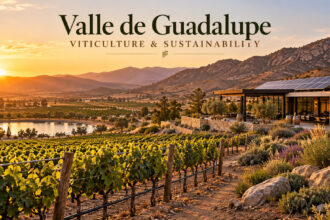
Nestled within the rugged coastal mountain ranges of Baja California, just twenty miles northeast of the Pacific port city of Ensenada, the Valle de Guadalupe has emerged as Mexico’s preeminent viticultural destination. Accounting for approximately seventy to eighty percent of Mexico’s commercial wine production, this semi-arid river valley combines dramatic granitic geology, centuries of agricultural adaptation, and a distinct maritime microclimate. Long celebrated by regional connoisseurs, the valley now attracts an international clientele seeking world-class estate bottlings, farm-to-table culinary architecture, and architectural boutique accommodations.
Navigating the valley effectively requires an appreciation of regional logistics, agricultural realities, and cross-border protocols. Whether executing a scenic coastal road trip along the peninsula or consulting our comprehensive breakdown of Driving Baja Highway 1D: Toll Logistics, Scenic Coastal Stops, and Transit Safety, successful travelers approach the Valle de Guadalupe with structured itineraries. Understanding the microclimatic variations between sub-valleys, road conditions along unpaved secondary trails, and entry-return procedures transforms an ambitious weekend excursion into a seamless immersion in modern Mexican oenology.
Microclimatic Mechanics and Regional Soil Architecture
The viticultural success of the Valle de Guadalupe is an ecological paradox. Situated at approximately 32 degrees north latitude—traditionally considered too warm and equatorial for fine viticulture—the valley overcomes latitude through its intimate relationship with the Pacific Ocean. The Cold California Current produces a heavy, persistent maritime marine layer (locally known as la garúa) that sweeps inland every evening through the coastal gap at San Antonio de las Minas.
This nightly fog bank blankets the vine canopy in moisture, lowering ambient vineyard temperatures into the low 50s Fahrenheit, even during midsummer harvest cycles when daytime heat regularly exceeds 95 degrees Fahrenheit. This extreme diurnal temperature shift—often fluctuating by forty degrees within a twelve-hour cycle—arrests acid degradation within ripening grapes while allowing prolonged phenolic maturity. The result is intense fruit concentration balanced by structural acidity and mineral salinity rarely matched in warm-climate viticultural regions.
The valley’s soil composition further dictates variety selection and rootstock performance:
| Soil Classification | Dominant Mineral Composition | Primary Sub-Valley Locations | Optimal Grape Varieties |
| Granitic Alluvial Decomposed Sand | Weathered granite, coarse quartz, high porosity | Valley Floor & Arroyo Seco beds | Grenache, Tempranillo, Chenin Blanc |
| Marine Clay Loam | High moisture retention, calcium carbonate strata | Foothills of San Antonio de las Minas | Nebbiolo, Cabernet Sauvignon, Merlot |
| Volcanic Basalt & Rocky Cobble | Iron oxide, fractured stone, low organic nutrients | High-elevation bluffs near El Porvenir | Syrah, Mourvèdre, Petit Verdot |
Because natural annual precipitation averages only ten to twelve inches—concentrated heavily in short winter downpours—water conservation represents the valley’s foremost agricultural priority. Forward-thinking winemakers employ sub-surface drip irrigation, collect seasonal runoff from local arroyos, and select deep-rooting drought-tolerant varietals such as Grenache, Syrah, and Italian Nebbiolo that thrive in nutrient-lean soils without excessive moisture.
Historical Foundations: From Franciscan Missions to Russian Molokan Colonists
While the Valle de Guadalupe’s modern winery expansion accelerated dramatically during the late 1990s, its viticultural legacy spans centuries of complex geopolitical migrations. Spanish Franciscan missionaries planted the earliest European Vitis vinifera vines along the Baja California peninsula during the late eighteenth century, producing sacramental wine from the heat-tolerant Mission grape (Listán Prieto).
A pivotal transformation occurred in 1905, when several hundred Russian pacifist Molokan families immigrated to the valley after fleeing religious persecution in Tsarist Russia. Granted agricultural land grants by Mexican President Porfirio Díaz, the Molokan community cleared extensive brush, established commercial grain farming, planted olive groves, and cultivated substantial acreage of wine grapes. Descendants of these founding families, including the Bibayoff family, continue to cultivate historic dry-farmed vineyards, maintaining agricultural continuity with the valley’s rural heritage.
The modern fine wine revolution began in 1987 with the founding of Monte Xanic by winemaker Dr. Ricardo Hojel and his partners, proving that Baja California could produce benchmark wines capable of competing on the international stage. Soon after, visionary winemakers like Hugo D’Acosta—trained in Montpellier and Bordeaux—pioneered artisanal, small-batch vinification methods and established La Escuelita (Estación de Oficios El Porvenir), an incubator that mentored dozens of contemporary boutique vintners who define the valley’s dynamic identity today.
Curated Tasting Itineraries and Architectural Profiles
The Valle de Guadalupe spans roughly fifteen miles from south to north along Mexico Federal Highway 3 and its intersecting rural routes. Because many boutique estates are tucked along unpaved, washboard dirt roads (caminos de terracería), travelers should resist the temptation to over-schedule. Limiting visits to three appointments per day preserves time for unhurried cellar tours, relaxed vineyard lunches, and safe driving between parcels.
- Historic Pioneer Route (Southern Valley & Highway 3): Begin at Monte Xanic, where a modern tasting facility borders a natural reservoir with expansive views of the valley floor. Sample their signature Cabernet Franc-dominated Gran Ricardo blend before proceeding to Bodegas de Santo Tomás, Baja’s oldest operational producer, which operates modern tasting rooms and historic olive processing equipment.
- Artisanal & Natural Exploration (San Antonio de las Minas): Explore the steep, hillside terraces near the valley’s coastal gateway. Estates here focus heavily on low-intervention vinification, spontaneous fermentation, and amphora aging. Tastings frequently feature unfiltered Chenin Blanc and whole-cluster fermented Rhone blends.
- Modern Architectural Vanguard (El Porvenir & Northern Flats): Venture north along the rural dirt spurs toward iconic architectural destinations like Bruma and Clos de Tres Cantos. Bruma’s winery is built around an ancient, living oak tree using repurposed maritime timber and rammed-earth construction, while Clos de Tres Cantos features monastic stone architecture built entirely from local river rocks and recycled glass.
- Baja Med Culinary Pairing (Lunch & Early Evening): Conclude your afternoon at pioneering open-air kitchen concepts such as Finca Altozano or Deckman’s en el Mogor. At Deckman’s, Michelin-starred chef Drew Deckman pioneered an entirely wood-fired outdoor kitchen operating within the Mogor estate, sourcing all ingredients, lamb, seasonal produce, and olive oils directly from the immediate ranch and local waters of Ensenada.
Essential Transit Logistics, Border Protocol, and Roadside Precautions
Executing a weekend journey into wine country requires careful logistical planning, particularly regarding vehicular preparation, currency, and border entry. Travelers driving from San Diego or Southern California should cross the international boundary through the San Ysidro or Otay Mesa ports of entry, continuing south along the coastal toll highway before linking to Federal Highway 3 at El Sauzal.

Mexican federal law mandates third-party auto liability insurance written by a licensed Mexican insurer; standard domestic auto policies issued in the United States and Canada do not satisfy this legal requirement. Comprehensive daily or annual policies can be purchased online in minutes, providing essential liability, legal defense, and roadside assistance coverage. Retain your physical proof of insurance inside the vehicle at all times.
While primary arteries like Mexico Federal Highway 3 are smoothly paved and maintained, secondary roads connecting remote boutique estates consist of hard-packed dirt, rocky washboard surfaces, and occasional sandy arroyos. While high-clearance sport utility vehicles (SUVs) are recommended, standard passenger cars can navigate most primary access roads during dry months if drivers maintain moderate speeds and remain observant of sudden dips (vados). Furthermore, always confirm your return timing: cross-border travelers returning through San Ysidro or Otay Mesa should monitor official border queue wait times on official platforms like the CBP Border Wait Times tracker, keeping original passports, passport cards, and SENTRI/Global Entry credentials easily accessible to ensure a streamlined inspection process upon return.
Embracing the Rhythms of Baja’s Viticultural Frontier
Visiting the Valle de Guadalupe is fundamentally an encounter with agricultural resilience, community vision, and unhurried hospitality. The valley avoids the commercial polish and rigid corporate formalities found in older global wine regions; instead, it offers an authentic, dust-on-the-boots atmosphere where estate owners and head winemakers regularly pour in their own tasting rooms. By approaching the region with respectful curiosity, supporting sustainable water initiatives, and lingering over twilight vineyard dinners, travelers participate directly in the ongoing cultural evolution of Mexico’s premier viticultural valley.