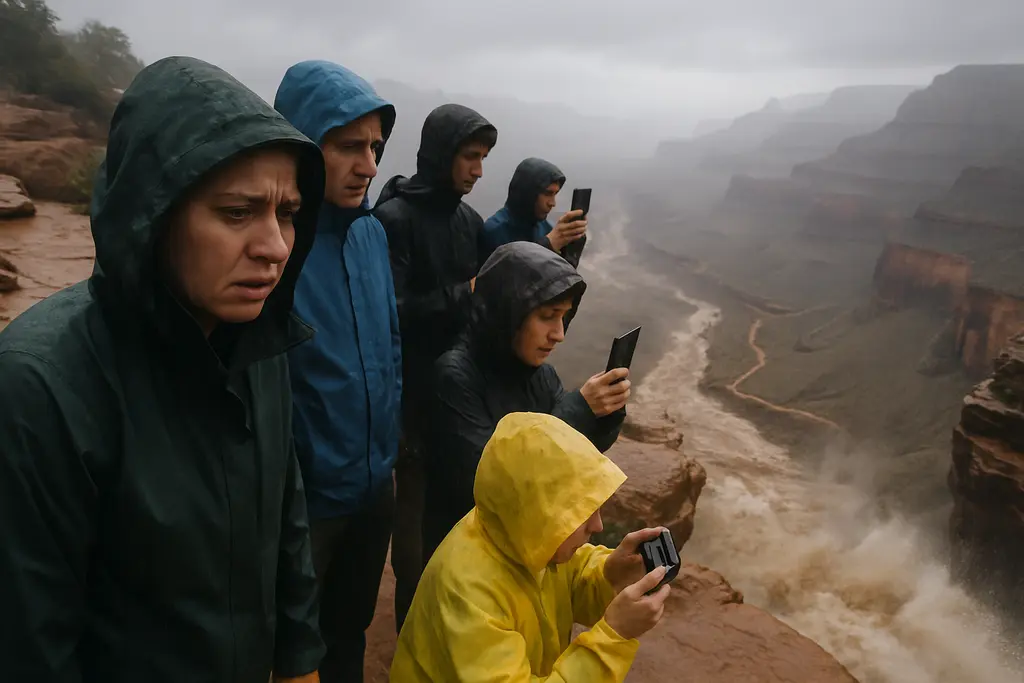
Grand Canyon flooding from the August 29, 2026, flash flood is still shaping visitor planning as of October 18, 2026. The practical issue is not whether Grand Canyon National Park is entirely closed; it is not. The sharper question is which services, trails, lodging options, water systems, and rim-to-rim assumptions no longer match a normal trip plan.
The National Park Service reported that the severe flash flood in Bright Angel Canyon and the Phantom Ranch area destroyed a water intake pump, damaged about 40% of the legacy Transcanyon Waterline, and affected intake areas at Bright Angel Creek and Roaring Springs, according to the NPS recovery plan. Those are infrastructure problems, not just trail-condition footnotes, and they explain why visitor services remain constrained weeks after the flood.
What Grand Canyon flooding Changed For Visitors
Grand Canyon flooding Status On October 18, 2026
For travelers reading Grand Canyon flooding updates, the key distinction is between day access and overnight capacity. Research notes indicate that park day use remains open, while all overnight lodging inside the park has been closed since August 31, 2026, under Stage 4 water restrictions on the South Rim. Dry camping is the only camping allowed under the reported restrictions.
The South Rim tap water is reported safe, and there is no boil-water advisory in the research notes. That point matters because a water-system emergency can easily be misunderstood as a drinking-water quality warning. The advisory described here is primarily about supply, distribution, damage repair, and limits on overnight services rather than a boil-water order.
Why Overnight Plans Need A Second Check
Travelers who booked around in-park lodging, Phantom Ranch access, or a classic inner-canyon overnight route should not assume the reservation pattern they know from prior years still applies. The reported closure of all overnight hotel accommodations inside the park changes the base-location decision for South Rim visitors. Gateway lodging outside the park may be the practical fallback, but the research notes do not provide current room rates, cancellation terms, shuttle details, or availability, so those details need direct verification before payment.
The economic effect is not limited to visitors. Lodging closures at South Rim viewpoints have hurt business revenues in Tusayan and nearby gateway communities, which were already recovering from prior wildfire-related losses, according to an Associated Press report. For travelers, that means local businesses may be dealing with unusual demand swings: fewer in-park overnight guests, more last-minute rebooking questions, and uncertainty around restoration dates.
How Grand Canyon flooding Affects South Rim Logistics
Water Restrictions And Restoration Timing
Grand Canyon flooding has created a planning problem around water availability as much as trail access. Research notes state that South Rim water use is about 137,000 gallons per day and that an agreement is being sought to haul about 200,000 gallons per day to stabilize reservoirs until the intake and pumping system can operate. More than 4.5 million gallons of water are expected to be delivered by truck before the current hauling contract concludes.
The projected restoration timeline is phased rather than immediate. Water service to South Rim residences and concessionaire lodgings is projected to begin with pumping via the Bright Angel Creek intake by November 16, 2026, with distribution by Thanksgiving in late November. That projection is useful for trip planning, but it should not be treated as a guarantee of full visitor-service recovery on a single date. A phased water restoration can begin before all lodging, trail, and facility impacts are resolved.
What Day Visitors Should Expect
Day visitors still need to plan as if services are constrained. The research notes support that day use remains open, but they also support continued Stage 4 water restrictions, closed in-park overnight lodging, and dry camping only. A South Rim day trip may still be worthwhile for viewpoints and short visits, but it should be planned with conservative assumptions about water use, food timing, parking, restroom availability, and the risk that conditions may change before arrival.
For those considering air travel, travelers flying into the broader region and then driving should separate aviation logistics from park-access facts. A related site in the same network, Vision Airlines, can provide broader insights into aviation topics, while decisions related to Grand Canyon access, lodging, trail, and water should be verified with official park updates before any bookings.
Trail And Inner-Canyon Access Limits
Closures That Change Classic Hiking Plans
Many inner-canyon trail and facility closures remain indefinite in the research notes. These include Phantom Ranch, Bright Angel Campground, and the North Kaibab Trailhead to Phantom Ranch. Other reported closures include Bright Angel Trail below the Tonto Trail intersection and South Kaibab Trail below Tip-Off. Those details affect more than backpackers; they also affect rim-to-rim hikers, mule-trip assumptions, family plans built around Phantom Ranch, and any itinerary that depends on inner-canyon water or overnight stops.
For a narrower hiker-access reading, this related BajaTimes planning note on Grand Canyon hiker access tracks how closures can change route choices, water assumptions, and overnight planning. The wider lesson is consistent: visitors should not use older trail memories or saved route maps as proof that an inner-canyon plan remains available.
Why Rerouting Is Not Always Simple
When a trail segment closes inside Grand Canyon, the substitute is not always another nearby path with the same water access, shade, distance, elevation profile, and emergency options. The reported closures touch central corridor routes and facilities that normally carry significant visitor demand. A change from one corridor route to another can affect total mileage, descent time, heat exposure, turnaround decisions, and whether a plan remains appropriate for the group.
Travelers should also avoid treating partial access as a green light for ambitious hikes. A route may be open at the rim while a lower segment remains closed. A viewpoint walk and a canyon descent require very different planning standards. The current advisory picture supports a cautious reading: confirm the specific trail segment, not just the trail name.
North Rim Access And Seasonal Limits
Open Season Does Not Mean Full Service
The North Rim is reported open for the 2026 season through November 30, 2026, or until the first major snowstorm. That language matters because weather can shorten the practical season. Research notes also state that the North Rim Campground closed for the season on October 15, 2026, while lodging is available with limited facilities and services.
That makes the North Rim a possible alternative for some visitors, but not a simple replacement for South Rim lodging or inner-canyon plans. The North Rim sits in a different travel pattern, has seasonal constraints, and has fewer services even during normal shoulder-season periods. Visitors considering it should verify lodging status, food options, road conditions, and fuel planning before treating it as a backup.
Scenic Drive Closures After Sunset
Research notes report that Cape Royal Road and Point Imperial Road are closed nightly from sunset on October 15 to sunrise on November 3, 2026, for road repairs. That affects photography plans, sunset drives, and late-day sightseeing. A visitor who arrives near dusk may find that the drive they expected to use is no longer available that evening.
The timing also affects road-trip pacing. A North Rim visit in late October is not just a question of whether the entrance is open. It is a question of daylight, road-repair windows, campground status, limited services, and weather. Travelers should build plans around explicit dates and times rather than a broad assumption that the rim is open through late November.
Booking, Cost, And Access Uncertainty
What The Research Does And Does Not Establish
The available research supports several firm points: the August 29 flood caused major water-system damage; South Rim Stage 4 water restrictions have been in place since August 31; in-park overnight lodging is closed; tap water is reported safe with no boil-water advisory; several inner-canyon facilities and trail segments remain closed indefinitely; and North Rim access is seasonal with limited services.
The research does not establish a change in entrance fees, private gateway-hotel pricing, transportation costs, or the exact date when normal in-park lodging inventory will return. Visitors should treat those as open questions. Booking decisions should be based on direct confirmation from lodging operators, official park status pages, and cancellation policies that account for water restoration delays or further access changes.
Practical Checks Before Paying
- Confirm whether your plan requires in-park lodging, Phantom Ranch, Bright Angel Campground, or closed trail segments.
- Ask lodging providers whether water restrictions affect services, cancellation terms, check-in expectations, or food options.
- Check whether a North Rim plan depends on roads subject to nightly closures or seasonal shutdown after a major snowstorm.
- For hiking, verify the exact open segment, not only the trail name.
- Build a backup plan that does not depend on the projected November 16 water-pumping date or Thanksgiving distribution target.
Grand Canyon flooding Planning Checks For Visitors
How To Read The Advisory Now
The clearest reading of Grand Canyon flooding conditions on October 18, 2026, is that the park remains visitable for some day-use plans, but not in the full-service pattern many travelers associate with the South Rim. Water restrictions, closed in-park lodging, dry-camping limits, damaged infrastructure, and indefinite inner-canyon closures are still central to trip planning.
A reasonable visitor plan should start with the question: does this trip depend on overnight infrastructure inside the park or on a specific inner-canyon route? If the answer is yes, the risk of disruption remains high enough to justify direct verification before booking. If the answer is no, a shorter day-use visit may still be possible, but it should be planned around limited services and changing access details.
The most useful approach is to avoid old assumptions. Do not rely on a prior rim-to-rim itinerary, a past Phantom Ranch plan, a saved lodging search, or a general statement that the park is open. Use the exact date, rim, road, trail segment, lodging provider, and water condition that applies to the trip. That is the difference between a realistic Grand Canyon visit and a plan built for conditions that no longer exist.