The World Cup celebration incident in Cabo San Lucas is a painful reminder that public soccer energy needs public-space planning. After Mexico’s June 24, 2026, win over Czechia, a crowd celebrating in downtown Cabo San Lucas spilled into a vehicle corridor on Bulevar Lázaro Cárdenas. A car struck fans, at least 17 people were injured, and the driver, Roberto Arellano, later died after being attacked by people at the scene. For Baja California Sur and the wider Baja region, the lesson is not to treat fan celebrations as spontaneous street overflow. It is to design safer public fan zones before high-emotion matches push people, cars, alcohol, and tourism traffic into the same space.
Why The Cabo Incident Matters Beyond One Night
Cabo San Lucas is one of Mexico’s most recognizable tourism destinations, but the June 24 incident did not happen in an isolated resort setting. It unfolded in the city’s public street environment, where residents, workers, visitors, vehicles, bars, hotels, and celebration crowds can overlap quickly after a major match.
El País reported that hundreds of people were celebrating Mexico’s 3-0 victory over Czechia when Roberto Arellano’s vehicle moved through Bulevar Lázaro Cárdenas amid a dense crowd. The report said the incident left 17 people injured and that four people remained under medical observation after the driver’s later death. It also described videos showing a festive but volatile atmosphere where pedestrians and vehicles were sharing the same space before the crash through the Cabo San Lucas incident report.
For Baja travel coverage, the key issue is not blame alone. Authorities are investigating what happened, and the human cost deserves careful language. The broader planning question is how destinations can keep public celebration alive without allowing crowds and cars to mix in ways that create obvious risk.
That question applies to Cabo San Lucas, La Paz, Tijuana, Ensenada, Mexicali, San José del Cabo, and any Baja destination where soccer crowds may gather during World Cup matches.
What Officials Said After The Incident
Los Cabos municipal officials responded immediately after the incident. The Los Cabos government reported that Dr. José Manuel Larumbe Pineda, Primer Regidor acting as municipal president by law, and Alberto Rentería Santana, Secretary General of the Ayuntamiento, visited hospitals in Cabo San Lucas during the early hours of June 25 to provide direct attention to victims of the crash through the official Los Cabos hospital response.

That official response matters because public fan-zone planning is not only a tourism issue. It involves health services, municipal government, traffic police, civil protection, emergency access, and communication with families. A celebration that begins as sports tourism can become a medical-response situation within minutes if the site is not managed.
The municipality also later announced a special security and vehicle-control operation for a Mexico national-team match in downtown Cabo San Lucas. The Dirección General de Seguridad Pública, Policía Preventiva y Tránsito Municipal said the measure responded to expected high attendance in the downtown zone and was intended to protect attendees and manage vehicle circulation through a Cabo San Lucas traffic-control operation.
That sequence shows the planning shift. After a spontaneous celebration exposed the danger of mixed vehicle and pedestrian flows, officials moved toward more deliberate control of streets and crowd movement.
Why Streets Are Not Automatic Fan Zones
A street can become a public celebration space, but it does not become safe just because people gather there. Streets are designed for movement, not standing crowds. When a crowd fills a vehicle route after a match, the space can lose its original logic. Drivers may be trapped, pedestrians may assume the road belongs to them, emergency vehicles may lose access, and anger can escalate when people feel blocked, threatened, or disrespected.
That appears to be the practical danger exposed in Cabo San Lucas. The issue was not simply that people celebrated. Celebration is part of World Cup culture. The issue was that celebration happened in a space where cars and pedestrians were not clearly separated at the moment when emotions were highest.
For Baja destinations, this is where public fan-zone design matters. If officials expect fans to gather after Mexico matches, they need to decide in advance where people can stand, where cars can move, where emergency vehicles enter, where families can exit, and where bars and restaurants direct customers after the final whistle.
The goal is not to suppress celebration. It is to remove predictable conflict points before they become dangerous.
How This Connects To Baja Fut Fest And Tijuana
Tijuana’s Baja Fut Fest offers a useful contrast because it creates a planned public viewing corridor rather than relying only on spontaneous street celebration. BajaTimes has already covered how Tijuana Baja Fut Fest turns Avenida Revolución into a World Cup tourism corridor with public viewing, food activity, and visitor movement.

That does not mean Tijuana has no risk. Any public event on a famous tourism street requires crowd control, restroom planning, emergency access, family routes, transportation options, and coordination with nearby businesses. But the planned-event model gives organizers a better chance to shape movement before fans improvise.
Cabo’s incident shows why that matters. A crowd after a Mexico win can become bigger, louder, and less predictable than a normal tourism evening. If a city has not created a clear place for that energy, fans may create one themselves in the street. That can place them directly in conflict with traffic.
For Baja California and Baja California Sur, the strongest approach is not to wait for crowds to decide the geography. It is to predefine fan areas, communicate them clearly, and adjust them by match importance.
Why Match Stakes Change Public Safety Needs
Not every World Cup match produces the same crowd. A neutral group-stage match at midday is different from a Mexico knockout match at night. A low-attendance watch party is different from a citywide celebration after a dramatic win. A family viewing zone is different from a bar-heavy street after several hours of drinking.
This is why fan-zone planning should change by match. Mexico matches, U.S. matches with cross-border appeal, semifinals, finals, and rivalry games need more planning than ordinary fixtures. They may require street closures, visible pedestrian corridors, vehicle diversions, more lighting, transit guidance, first-aid presence, and a clear post-match dispersal plan.
In Cabo, the problem did not end when the match ended. The highest-risk moment came after the result, when celebration moved into the street. That is a key lesson for every Baja destination. The post-match window may be more important than the broadcast itself.
A safer fan zone should answer what happens in the 30 minutes after the final whistle. Where do people go? Which streets remain closed? Where do ride-shares pick up passengers? How do families leave? How do emergency responders enter? What happens if the celebration grows beyond the original footprint?
What Safer Public Fan Zones Need
A safer fan zone does not need to feel overcontrolled. It needs to make movement obvious. Visitors should understand where to stand, where to walk, where to find help, and where vehicles are not allowed. Drivers should not be asked to pass through a crowd that is celebrating a national-team result.
The most important planning step is separation. Pedestrians and moving vehicles should not share the same space during high-density celebrations. Temporary closures, barriers, cones, traffic officers, and alternate routes can reduce confusion. Clear signage and staff direction can help visitors feel guided rather than trapped.
A second step is capacity thinking. If a public area is expected to attract hundreds or thousands of fans, officials need to know how many people the space can reasonably hold. A street with restaurants, bars, parked cars, vendors, sidewalks, and intersections may not handle the same crowd as an open plaza or controlled park.
A third step is exit planning. Many public-event problems happen when everyone leaves at once. Fan zones need visible exit routes, taxi or ride-share areas away from the densest crowd, and communication with hotels and businesses so visitors are not pushed into vehicle corridors.
What Hotels, Bars, And Restaurants Should Learn
Cabo’s tourism economy depends heavily on hotels, restaurants, bars, tours, and nightlife. Those businesses cannot control the whole street, but they can influence how guests behave after major matches. A bar that shows a Mexico match should not simply let customers spill into traffic without guidance. A hotel near a celebration area should help guests understand which streets may close and where to walk. Restaurants should prepare for crowds that may arrive emotional, hungry, or impatient after a result.
Businesses can also help by coordinating with municipal authorities before high-demand matches. That may include adjusting entry lines, keeping doorways clear, avoiding sidewalk bottlenecks, directing ride-shares away from crowded intersections, and giving guests practical safety reminders without creating fear.
For visitors, the message should be simple. Celebrate, but do not assume every street is a plaza. Follow closures, avoid surrounding vehicles, stay with your group, and leave crowded areas before they become harder to move through.
This is not about making Cabo less festive. It is about protecting the visitor experience and the people who live and work in the city.
What Travelers Should Check Before Joining A Cabo Celebration
Travelers in Cabo San Lucas during a major World Cup match should think like event attendees, not just restaurant customers. A spontaneous celebration may feel exciting, but it can change the transportation environment around downtown very quickly.
| Planning Question | Why It Matters | Safer Move |
|---|---|---|
| Is The Street Closed To Vehicles? | Mixed traffic and crowds create the highest risk | Stay inside pedestrian-only areas |
| Where Is The Hotel Or Ride-Share Pickup? | Post-match crowds can block normal routes | Choose a pickup point outside the densest zone |
| Is The Group Staying Together? | Crowds can separate families and friends | Set a meeting point before kickoff |
| Is Alcohol Changing The Mood? | Public celebrations can escalate after emotional results | Leave early if the crowd feels unstable |
| Can Emergency Vehicles Enter? | Crowded streets can block medical response | Avoid standing in intersections or vehicle lanes |
These checks are especially important for families, older travelers, and visitors unfamiliar with Cabo’s downtown streets. A resort guest who rarely walks the city at night may not understand how quickly a celebration can reshape traffic. A day visitor may not know alternate routes. A group of fans may underestimate how long it takes to leave after a match.
The safest plan is to decide the exit before the celebration begins.
Why Public Fan Zones Are A Tourism Asset When Planned Well
Public fan zones can be good for Baja tourism. They bring people into restaurants, create shared memories, support hotels, and let visitors experience the World Cup beyond a private resort or hotel bar. They can also make destinations feel more welcoming when tickets are expensive or stadiums are far away.
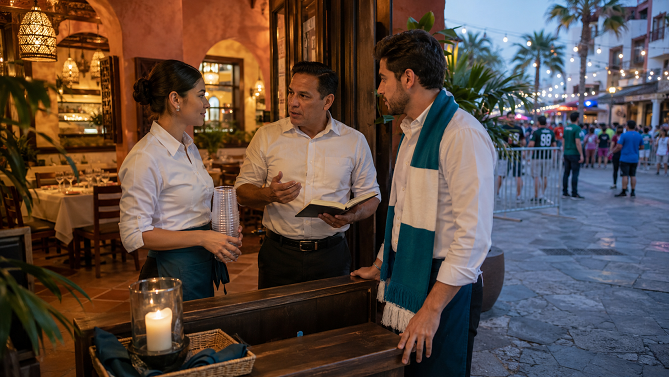
But fan zones only strengthen a destination when visitors feel the event is managed. A well-planned public viewing area can show that a city is organized, family-aware, and ready for large events. A poorly planned celebration can create fear, confusion, injury, and negative coverage that lasts longer than the match result.
That is why Cabo’s incident should be treated as a planning case, not only a tragedy. It shows that high-emotion sports moments need street design, traffic policy, crowd communication, and emergency planning. It also shows that destination reputation depends on what happens outside the stadium, outside the resort, and after the broadcast ends.
Baja’s World Cup opportunity is still strong. Tijuana, Los Cabos, Ensenada, La Paz, and other destinations can use soccer to support local businesses and visitor experiences. The responsibility is to make public enthusiasm safer.
How Baja Destinations Can Adjust Before The Next Big Match
The practical path forward is clear. Cities should identify high-demand matches in advance, decide which streets will close, create pedestrian-only celebration areas, communicate alternate routes, coordinate with bars and restaurants, and plan the exit window after the final whistle. Officials should also make sure emergency vehicles can reach the site and that families know where to find help.
Los Cabos has already moved toward special vehicle-control operations after the incident. That is a necessary step, but the broader lesson applies across Baja. If people are likely to celebrate in the street, the street must be managed as an event space.
For travelers, safer fan zones make the experience better. They reduce uncertainty, help families plan, and let visitors enjoy the match without worrying about cars moving through the crowd. For businesses, they protect foot traffic and reduce chaos. For cities, they turn World Cup energy into a controlled tourism asset rather than a public-safety gamble.
Cabo’s June 24 incident was severe, and the people injured deserve more than a passing mention. The most useful response is to learn from it. Baja can still celebrate the World Cup in public, but the next celebration needs clearer streets, safer exits, and a plan that treats fans as pedestrians first.