Yellowstone Trip Planning in 2026 calls for more than choosing geysers and viewpoints. Costs, road openings, lodging release dates, road work, wildlife distances, thermal-area rules, weather swings, and limited connectivity all affect how a park visit works on the ground. The safest approach is to build the trip around confirmed dates and official fee rules, then leave room for delays rather than packing each day too tightly.
As of August 28, 2026, some 2026 fee-free days had already passed, including the July 3-5 Independence Day weekend and Preservation Day on August 25, 2026. That matters for travelers reading older trip advice. A day described earlier in the year as free admission may no longer help with cost planning, and non-U.S. residents face a separate fee rule that applies even on listed fee-free days.
Yellowstone Trip Planning Costs And Entrance Rules
Standard 2026 Entrance Fees
For 2026, Yellowstone Trip Planning starts with the entrance fee. A standard seven-day pass for a private vehicle costs $35. A motorcycle or snowmobile pass costs $30, and an individual entering on foot, bicycle, or similar non-vehicle access costs $20, according to the park’s official Yellowstone fee page. These are entrance charges, not lodging, camping, food, fuel, or tour costs.
Travelers should treat the seven-day pass as a planning window, not a promise that every road or activity will be available. Yellowstone’s road access is seasonal, and some areas may require longer drive times than a map suggests, especially when construction is active or wildlife slows traffic.
Yellowstone Trip Planning For Non-U.S. Visitors
Starting January 1, 2026, non-U.S. residents age 16 and older pay an extra $100 per person in addition to the standard entrance fee unless they hold a valid Annual or America the Beautiful pass. The National Park Service explains this 2026 policy in its National Park Service nonresident fee notice. Fee-free days in 2026 apply to U.S. residents only, so non-U.S. residents still need to budget for entrance charges plus the nonresident fee on those days.
This change can make a family or group trip cost noticeably different depending on residency and pass status. Before booking flights, lodging, or a rental vehicle, calculate park-entry costs for each traveler rather than using only the private-vehicle fee.
Reservations, Roads, And Delays
Lodging And Camping Release Timing
Inside-park lodging, campsites, and RV camping require advance reservations. The 2026 reservation system described in the research opens up to 13 months ahead, with lodging and campground inventory released on the fifth day of each month. For example, on April 5, 2026, travelers could book stays from April 1 through April 30, 2027.
That release pattern rewards early planning, but it also calls for realistic backup choices. If a desired lodge or campground is unavailable, travelers may need to adjust dates, split nights between areas, or stay outside the park. Anyone comparing air options should separate flight research from park access planning; broader aviation resources such as those found on websites like Vision Airlines can be part of that early trip-research stage, but road schedules and lodging availability still need separate confirmation.
Seasonal Road Dates To Check
Good Yellowstone Trip Planning treats road dates as fixed planning inputs until the park updates them. Most roads for regular vehicles are scheduled for mid-April through late October 2026. West Entrance to Madison, Madison to Old Faithful, and Mammoth Hot Springs to Norris are listed for April 17 through October 31, 2026. East Entrance via Sylvan Pass to Fishing Bridge and Canyon Village to Bridge Bay are listed for May 1 through October 31, 2026. Canyon Village to Tower Fall via Dunraven Pass is listed for May 22 through October 12, 2026.
The only road typically open to regular vehicles throughout the year, weather permitting, is from the North Entrance at Gardiner, Montana, through the park to Cooke City, Montana, via Tower Junction. That year-round status should not be read as a guarantee against winter or storm-related disruption. Travelers using that corridor still need to check conditions close to departure.
Construction And Time Buffers
Through September and into October 2026, published park alerts identified intermittent lane closures and delays, especially along Hayden Valley on Grand Loop Road, at the Yellowstone River Bridge near Tower Junction, and during overnight work on the Madison River Bridge. Typical waits were listed at 10 to 30 minutes.
That does not sound long in isolation, but two or three delays can change a day. Travelers should avoid planning back-to-back timed activities across distant parts of the park. If your route crosses a construction area, leave earlier, carry water and layers in the vehicle, and keep meal plans flexible. For broader route and booking risk checks, BajaTimes has also covered a cautious method for smarter trip choices before committing to hotels, tours, and routes.
Safety, Weather, And Low-Service Areas
Wildlife Distance Rules
Yellowstone wildlife is not scenery to approach for a closer photo. The 2026 safety guidance in the research says visitors should stay at least 100 yards, or 91 meters, from bears, wolves, and cougars. Visitors should stay at least 25 yards, or 23 meters, from bison, elk, and other animals. Yellowstone is all bear country, and the guidance says to carry bear spray and know how to use it.
Those distances affect practical trip behavior. Bring a lens rather than stepping closer. If wildlife blocks a road or trail, wait from a safe place instead of trying to pass closely. Parents should set expectations with children before arrival, because the distance rules apply even when animals appear calm.
Thermal Areas And Boardwalks
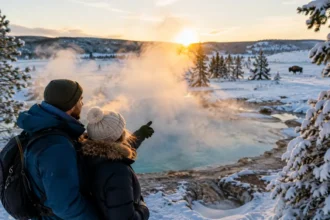
Thermal areas require a different kind of caution. The ground around geyser basins and hot springs can be fragile and may collapse. The research notes that serious injuries and deaths occur each year when visitors leave designated paths. Staying on boardwalks is not only a park rule; it is a basic safety practice.
This is especially relevant for first-time visitors who may underestimate how thin the ground can be near hot springs. Do not step off a boardwalk for a photo, to avoid a crowd, or to retrieve an item. If something falls into a thermal area, report it rather than trying to recover it.
Weather And Connectivity Limits
Yellowstone weather can shift quickly. Even summer days may bring rain or snow, so travelers should pack multiple layers, warm clothing, and waterproof gear. Cell service and internet are extremely limited through much of the park. Download maps, reservation details, entrance information, and key route notes before arrival.
Low connectivity changes how a trip feels. A phone map may not update, a hotel confirmation may not load, and a weather app may lag. Print or save the essentials offline: lodging address, reservation number, planned road segments, emergency contacts, and any route notes tied to construction or seasonal access.
Yellowstone Trip Planning Checklist For 2026
What To Confirm Before You Book
The practical value of Yellowstone Trip Planning is that it reduces avoidable surprises without pretending the park is predictable. Before booking, confirm your travel dates against road-opening schedules, calculate entrance costs based on residency and pass status, and check whether your preferred lodging or campsite can be reserved during your target month.
- Budget for the 2026 seven-day entrance fee: $35 for a private vehicle, $30 for a motorcycle or snowmobile, or $20 for an individual entry.
- If any traveler is a non-U.S. resident age 16 or older, account for the $100 per-person nonresident fee unless a valid qualifying pass applies.
- Match planned drives to the published 2026 road dates, especially for Dunraven Pass, Sylvan Pass, Old Faithful access, and the North Entrance route.
- Reserve lodging, camping, or RV sites early, using the 13-month release pattern and the fifth-day monthly inventory release.
- Allow for 10-to-30-minute construction waits in the identified 2026 work zones during September and October.
- Pack for variable weather, limited connectivity, wildlife distance rules, and strict boardwalk use in thermal areas.
A careful 2026 Yellowstone plan should be specific, but not rigid. The park’s scale, seasonal access, wildlife, road work, and weather all reward visitors who prepare early and keep daily plans realistic. Build the trip around verified costs and dates first; then choose the hikes, geyser basins, viewpoints, and lodging pattern that fit the access available during your exact visit window.